
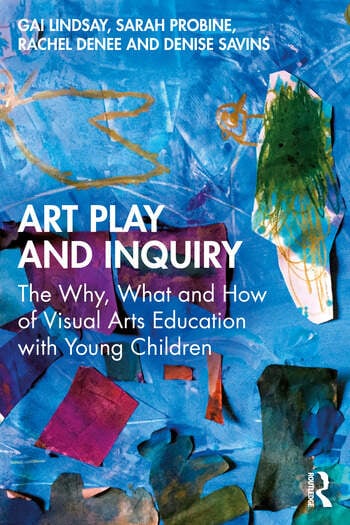
In this blog, I share some questions and answers to introduce you to our forthcoming book. It took just under three years of collaborative writing to write the book with my co-authors, Dr Sarah Probine, Dr Rachel Denee and Denise Savins. I would also like to recognise Dr Lisa Terreni for our initial discussions about how the book needed to tackle the WHY, the WHAT and the HOW of visual arts education. We can’t wait to hear about how our colleagues will use it to inform, inspire and guide their visual arts pedagogy and practice! See links to order the book at the bottom of this blog.
In this book, we bring together theory, practical guidance, and visual inspiration to support educators, and anyone working with young children, to create rich, joyful visual arts learning experiences. Drawing on our years of experience and research, we offer practical and theoretically informed insights alongside reflective prompts and vibrant visual examples to help the adults in children’s lives to understand the why, what, and how of visual arts education.

Our aim is to connect theory and practice in ways that inspire meaningful interactions with children and materials. We believe that fostering creativity in children begins with adults embracing their own playful inquiry and curiosity.
Image L to R: Dr Rachel Denee, Dr Gai Lindsay, Denise Savins and Dr Sarah Probine.
We make no assumptions about prior knowledge. This book is for everyone, whether new to visual arts education or looking to deepen your practice.
The book is structured in three parts, guiding readers through the importance of visual arts, what a rich curriculum can look like, and how to bring it to life. We encourage educators to move beyond step-by-step activities to instead cultivate authentic, relationship-based encounters with visual art tools, materials, and processes. This is a resource for educators, parents, students, and academics who want to nurture children’s creative potential and reimagine the potential of meaningful visual arts experience and inquiry.
Q1: As a collaborative work among four authors (Gai Lindsay, Sarah Probine, Rachel Denee, and Denise Savins), how did your diverse backgrounds and experiences shape the development of this book?
As co-authors, our diverse backgrounds and shared experiences were central to shaping this book. All four of us are qualified early childhood teachers who have had a wealth of experiences working with infants, toddlers, and young children. As experienced early childhood teachers, academics, and arts practitioners, we have found that while most educators believe visual arts learning is important for children, many express a lack of confidence regarding visual arts pedagogy and practice, often grounded in low visual arts self-efficacy, personal confidence, and knowledge.
The academics in our team, Gai, Sarah, and Rachel, share a research focus on educator visual arts self-efficacy and how this can impact children’s experiences and learning in the visual arts. All three of our doctoral studies explored aspects of young children’s experiences of the visual arts and the role of the teacher in shaping those experiences. This body of research informed our intention to help educators not only understand why visual arts matter, but also to build their confidence and capability to teach it, developing both the practical knowledge and self-efficacy needed to engage meaningfully with the arts in early childhood settings.
Denise brings an important practitioner lens to the book. Her expertise as a visual artist and atelierista, working with children aged two to six, has brought an invaluable dimension to our collaborative process. Her deep understanding of art-making with young children and her commitment to fostering creativity and self-expression have added both authenticity and practical insight to the pedagogical approaches we share.
Drawing on both our research and our experiences of working with young children, we have worked together to bring a rich, practice-based lens to our work, grounding our ideas in the realities of studio practice and material exploration. Together, we created this book to offer both inspiration and practical support for educators seeking to transform their visual arts pedagogy.
Q2: Your book is organized around the “why, what, and how” framework. What led you to structure the book this way?
We chose the “why, what, and how” framework because we wanted to empower adults who work with children at every stage of their visual arts learning journey. Existing resources tend to either focus on the importance of the arts without offering practical strategies, or offer collections of activity ideas that lack the theoretical and pedagogical grounding needed to build educator confidence and capability. We saw the need for a book that brings these elements together. As educators ourselves, we understood that knowing why visual arts matter is essential, but not sufficient. Educators also need to know what a rich curriculum looks like and how to implement it in ways that are meaningful, intentional, and responsive to children’s learning.
By structuring the book around these three pillars, we aim to support educators in developing both their understanding and their practice, empowering them to move beyond surface-level activities and into deeper, more relational and inquiry-driven visual arts experiences. Throughout the book, we share rich examples of practice, drawn from our own teaching, research, and collaborations, that show how theory can be translated into inspiring, real-world experiences for children. This approach reflects our belief, grounded in research and years of practice, that rich visual arts pedagogy flourishes when educators have the inspiration, knowledge, and practical tools to confidently create meaningful encounters between children, materials, and ideas.

Q3: What common misconceptions about visual arts education do you hope your book will help dispel?
One of the key misconceptions we hope to dispel is the belief that you need to be naturally gifted to engage with the languages of the visual arts. Our book encourages educators to see themselves as capable co-learners and co-artists alongside children, building confidence and fluency in the language of visual arts through experience, reflection, and playful inquiry.
We also challenge the notion that process and product are opposing concepts. We believe both are important. The process is enriched when the product bears witness to children’s thinking, engagement, and the quality of their experiences. A meaningful product can reflect the depth of the learning process and can also serve as a valuable reference point, enabling children to revisit and reflect on their previous thinking before beginning or continuing new artworks.
Another misconception is that simply offering sensory play with materials is enough. We advocate for repeated, sustained encounters with visual arts materials and processes, helping children develop a visual vocabulary and expressive capacity over time. We also argue that adults can play a vital role in children’s sensory exploration, deepening children’s experiences by taking an interest in their ideas and strategies, asking thoughtful questions, and offering suggestions that extend their thinking. Importantly, educators need to develop their own knowledge of the materials so they can scaffold children’s exploration in informed, responsive ways.
Above all, we want educators to know that even if they currently lack confidence, they can learn to speak the languages of the visual arts,and, in doing so, enrich both their own pedagogy and the quality of children’s learning experiences.
Q4: What benefits have you observed when children are given opportunities to express their ideas and feelings through visual arts?
When children are supported to express their ideas and feelings through the visual arts, they often enter a state of deep, joyful immersion, fully engaged in exploring materials, testing ideas, and making discoveries. These embodied, relational encounters nurture agency, allowing children to witness the power of their own voice and thinking.
Visual arts languages offer more than creative expression; they are powerful conduits for representing theories, emotions, and responses to the world, while fostering connection with peers and educators. Thoughtfully presented materials invite children to play, explore, and express, creating opportunities for meaningful collaboration and shared inquiry.
Over time, repeated and intentional encounters with materials help children develop a visual vocabulary, strengthening their capacity for symbolic thinking and communication. Adults play a vital role in this process, co-learning alongside children, asking questions, offering suggestions, and providing informed, scaffolded support that deepens exploration.
The benefits extend beyond creativity, children build confidence, persistence, and expressive fluency. They learn to make meaning visually, to revisit and refine their ideas, and to see themselves as capable creators. In doing so, they not only enrich their own learning but contribute to the collective culture of the learning community.

Q5: How might the approaches in your book be adapted for different cultural contexts or educational philosophies?
The approaches in our book are grounded in values that can be readily adapted across diverse cultural contexts and educational philosophies. At the heart of our work is the belief, articulated in Article 31 of the United Nations Convention on the Rights of the Child, that all children have the right to participate fully in cultural and artistic life. We also hold a deep respect for children’s capabilities and readiness to learn, and we view the visual arts as a central “language” through which children make meaning, communicate ideas, and express their experiences.
Drawing on Loris Malaguzzi’s concept of the hundred languages, we see visual arts as both a personal and cultural means of expression, capable of bridging differences while celebrating diversity. We encourage educators to reflect on how visual arts pedagogies can support children’s agency, voice, and connection, regardless of the curriculum model they follow. Whether in play-based, inquiry-led, or more structured environments, the values underpinning the book, respect, responsiveness, and relational engagement, can be translated into meaningful practice that honours both the child and the cultural context in which they learn.
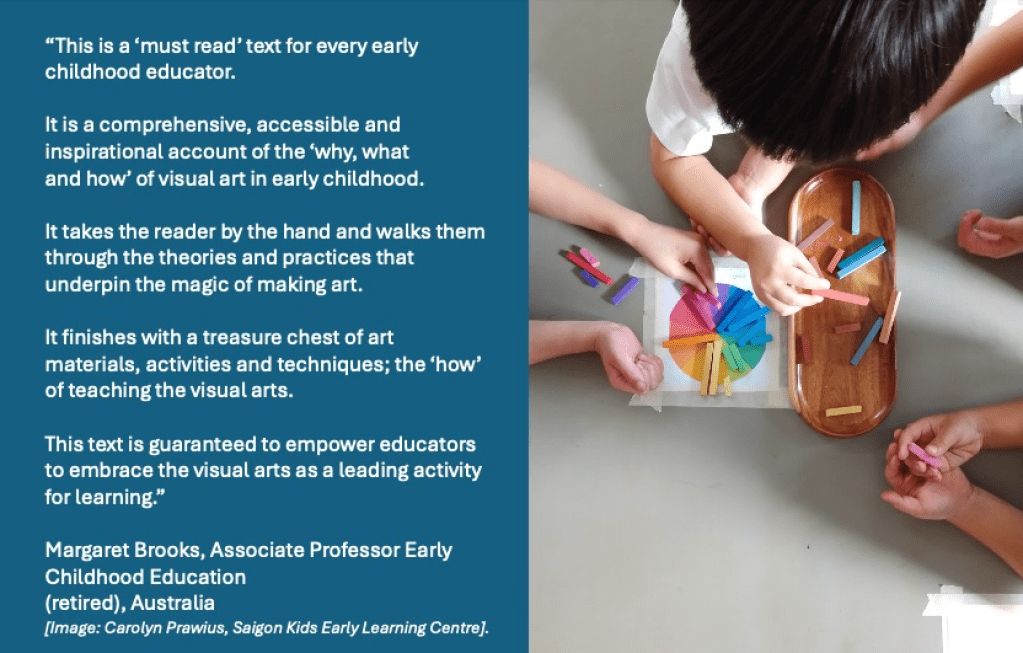
Q6: How do you hope this book will “directly impact” early childhood arts practice, as mentioned in the endorsements?
We hope this book will directly impact early childhood visual arts pedagogy by equipping educators to see themselves as central to quality visual arts experiences. Our aim is to strengthen both visual arts self-efficacy and pedagogical content knowledge, so educators feel confident to engage with materials, processes, and children in playful, informed, and intentional ways.
Educators do not need to be trained artists to support children’s artistic expression. By developing their own visual arts knowledge, they can feel empowered to learn and grow alongside children, speaking the languages of the visual arts through shared exploration. It is not enough to simply know why visual arts are important, or to collect activity ideas without understanding the deeper pedagogical purpose that shapes meaningful learning experiences. When the why, what, and how are understood together, educators are better equipped to make intentional choices that honour children’s rights to full participation in cultural and artistic life.
Through offering theory, practical strategies, and rich examples of practice, we aim to inspire a shift from one-off, surface-level activities to sustained, relational, and inquiry-driven experiences where children’s ideas, voices, and agency are truly valued.
TO PURCHASE OUR BOOK SHOP WITH:
We sincerely thank the colleagues, artists and friends who provided images and case studies for the book. Thanks to the following for sharing their work with our readers.
Aurora International School Of The Arts, Ho Chi Minh City, Vietnam; Blue Gum Community School, Canberra, Australia; Bomaderry Community Preschool, Bomaderry, Australia; Bundanon, Shoalhaven, Australia; Daisies Early Education & Care Centre, New Zealand; Dripstone Children’s Centre, Darwin, Australia; Explore and Develop Castlereagh Street, Sydney, Australia;
Frances Forshlager, The Nature of Creativity; Joke den Haese, Erasmus Brussels University of Applied Sciences and Arts, Brussels, Belgium; Judith Urry, Northland School, Te Kura o Orangi Kaupapa, Wellington, Aotearoa New Zealand; Kathy Danko-McGhee, Fort Wayne, United States of America; Lyrebird Preschool, Nowra, Australia; Maitland East Preschool, Maitland, Australia; Pete Moorhouse, Bristol, United Kingdom; Saigon Kids Early Learning Centre, Ho Chi Minh City, Vietnam; Sherry Polley (artist), Indianapolis, United States of America; Sophia Preschool, New Zealand; The Friends Long Day Childcare Centre, Lismore, Australia; The Point Preschool, Oyster Bay, Australia; UOW Pulse Kids’ Uni, Wollongong, Australia
 ecARToz: Inquiry & Arty Play with Dr Gai
What a delightful read! Your perspective adds so much to the discussion.
LikeLike
Thanks so much.
LikeLike
I’m very interested in learning more via your book! I totally agree about art education being both process and product oriented. It’s tangible praxis at its most human level. And whose to say that the process ends with the product? I’ve experienced many instances whereby viewing and reflecting on the product either a student or myself in my own practice, will decide that it’s not actually “finished,” and will go through another experiential process-oriented phase to revise or expand the product.
Thanks for sharing this informative interview!
LikeLike
Dear Adam – thanks for your interest in our book. I completely agree that the process and the product are connected, synergistic and co-dependent – BOTH have value – back and forth for creator and appreciator! To follow my work please see my FB page – https://www.facebook.com/DrGaiLindsay and/or my website – https://drgai-lindsay.com.au/
Best regards and please let us know what you think of the book!
Dr Gai Lindsay
LikeLike