
Dr Gai Lindsay and Melanie Finlay (Educational Leader and 2IC. Edgeworth Community Preschool).

Melanie Finlay
Edgeworth Community Preschool is a small 20-place service where children are recognised as capable, curious individuals with rights, voices, and ideas that matter. Here, play is powerful, childhood is celebrated, and every child is empowered to grow with confidence, joy, and a strong sense of belonging.
Introduction by Dr Gai Lindsay
I recently responded to a social media discussion about the use of templates on social media in response to a thoughtful post by Melanie Finlay, my co-author on this blog post. As usual there was contentious discussion about the pros and cons of templates (and colouring-in tends to come up in these discussions as well)…This conversation led me to wonder if the source of competing opinions about working with templates may also be based in the varied ways in which people interpret and define templates.
Although the Guide to the Australian National Quality Standard (NQS), Element 1.2.3 focus on Child‑directed learning outlines that instead of offering children templates and stencils that limit children’s capacity to create, interpret, experiment, and explore, we should be presenting children with open‑ended resources and materials that support them to express themselves (Guide to the NQF (2025, p. 141).
But I wonder….Do educators:
- Have a clear sense of what open-ended resources actually are?
- Know which experiences might limit children’s agency?
- Appreciate why being able to discern the difference between such experiences is important?
The arguments for and against stencils, templates and worksheets vary. Some educators defend structured tasks, believing strongly that they help with school readiness. Others defend stencils and templates as supporting development of fine motor, pre‑writing skills and school-readiness preparation. Educators who strongly oppose the use of stencils, templates and worksheets believe such activities restrict creativity and individuality, demand conformity, raise performance anxiety, impose adult drawn images and undermine children’s longer-term confidence and willingness to draw for meaning. Many early childhood professionals believe template and stencil approaches reduce art making processes to busywork designed to keep children busy, entertained, quiet and compliant. Meeting somewhere in the middle, some educators suggest balance is required and that allowing some use of stencils may offer a pathway or safe entry point into future artistic expression.
These competing viewpoints highlight that pedagogy and practice are never black and white and never clear-cut or easily defined. I hope that in grappling with these ideas, Mel and I can provoke pedagogical reflection, dialogue and even debate in your teams; and individually as you grow and extend your practice. Thanks to Melanie for agreeing to include her case study and reflections about this topic.
Are you equipped and confident to implement high-quality visual arts processes?
Think back to your own childhood. When did your attitudes toward art making begin to form?
Early experiences shape lifelong beliefs about personal artistic ability and creativity. Yet, too often, people’s memories of artmaking in their own childhood involve colouring inside someone else’s lines, following a pre-determined template or producing an outcome that was completely instructed by an adult.
As Sir Ken Robinson proposed, the education system unfortunately prioritises high-stakes testing regimes around narrow perceptions of literacy, numeracy and science – rather than creating joyful and genuine education that caters to children’s interests, development and dispositions through holistic and connected learning experiences. In such contexts, the visual arts languages are sidelined and narrowed into homogenous activities that too often revolve around adult-determined outcomes and limiting processes that contain and direct children’s agency and engagement.
Watch Sir Ken talk about this here:
The arts offer a language of possibilities; and offer spaces where children have the freedom to design, wonder, explore, interpret, and experiment with arts materials, tools and processes.
Yet worksheets, photocopied templates, and stencils are too often offered as “art experiences” and justified for reasons related to compliance, entertainment, fine-motor development, school-readiness or even fun. While these kinds of activities may keep children busy and focused, they rarely honour the principles of authentic learning or the image of the child as capable and creative. Dewey (1902) warned that such activities can become comfortable and even desirable and through habitual routine but that they limit children’s opportunities to experience rich learning experiences that honour their curiosity and potential. He stated,
“Familiarity breeds contempt, but it also breeds something like affection. We get used to the chains we wear, and we miss them when removed…Unpleasant, because meaningless, activities may get agreeable if long enough persisted in. It is possible for the mind to develop interest in a routine or mechanical procedure, if conditions are continually supplied which demand that mode of operation and preclude any other sort. I frequently hear dulling devices and empty exercises extolled because ‘the children take such an ‘interest’ in them.’ Yes, that is the worst of it; the mind shut out from worthy employ and missing the taste of adequate performance, comes down to the level of that which is left to it to know and to do, and perforce takes an interest in a cramped experience” (Dewey, 1902 p.27-28).
Some of these ideas were raised by Melanie in her social media post, and she expands on these ideas in the following case study.
As you read it, consider where you stand in your own thinking and practice. Jot down your thoughts and questions…be reflective and reserve judgement on yourself and others. Put aside your assumptions to re-consider your beliefs, knowledge and values.
Case study reflection: No space for stencils and worksheets with predefined outcomes – by Mel Finlay
I vividly remember when my strong advocacy for child‑led learning and process art became cemented as part of my professional identity. It was twenty‑five years ago, and I was nineteen years old and working in a long‑day care setting in the 3–5 year room. At this particular service, the Early Childhood Teacher made all curriculum decisions. After two months of working there, I discovered that many of these decisions were heavily reliant on stencils and worksheets with predefined outcomes.
The ECT had made several copies of a stencilled mask as an extension for a child who had shown an interest in dress‑up play. I remember watching as children passively approached the table, noticing the mask the ECT had created as a “stimulus”. They sat at the table, often asking “what do I do here?”. Then they began colouring with the four pencils of specific colours that matched the teacher’s mask. I couldn’t help noticing the lack of conversation, interaction, and excitement during this activity. I was also struck by the indifferent approach these children had to this activity. After they had coloured in the masks, some children attempted to use the scissors to cut them out, often asking for help with this, commenting that the other teacher usually had them cut out. When they had finished their masks they shoved them in their bags. I wondered whether the children even remembered to tell their parents about the masks when bags were unpacked. I wondered what the parents thought about these obviously adult‑constructed items.
The following day I got to witness the transformative power of child‑led learning through meaningful art processes. A four‑year‑old boy approached me asking if there were any more masks left for him to colour in, asking, “but can you do the cutting out and help me colour it in because I’m not very good at it?” I explained that there were no more mask templates, but invited him to come and have a look at the materials available in the art area and create his own.
Then the magic happened. He carefully explored the art materials with intention, and then self‑sourced a box. Bringing it back to the table, he drew some rough circles for eyes. He then asked me to cut out the eye holes. I challenged his request with, “How else could you make the holes for your eyes?” He thought about this for a minute or two, then found a pencil and carefully poked holes in the eye part. Then, hesitantly, he tore off small pieces to make the eyes bigger. Deciding he wanted to add some hair, he approached a peer using a large sheet of black cardboard. After explaining what he wanted to create, I watched, in awe, as he effectively used the building blocks of negotiation to obtain some black cardboard. He stated his reason for wanting it, listened to the perspective of his peer, and together they decided it would be fair for him to have a small piece of the cardboard.
This child who had shown very limited interest in art was now deeply engaged and passionate about his work. There was an undeniable joy that came from this purposeful activity. He remained focused, self‑directed, and persistent, spending time tearing it into long strips to make the hair. If he happened to break a piece, he found sticky tape to attach the pieces together. To attach the hair to his mask, he initially tried using the glue sticks, only to discover it didn’t hold the hair on. “I know!”, he exclaimed excitedly, running over to find the large roll of sticky tape. He continued to work independently on his mask for the next thirty minutes, negotiated with peers about resources, then added a yoghurt cup for the nose, buttons for freckles, and painted around all these pieces with white paint.
Later, I overheard him explaining to a peer that he had created “Big Joe”, a character from a story his dad often read to him. The end product was not easily recognised as the character from the story his dad read to him. But the end product held a much deeper meaning. The end product was a reflection of this child’s self‑directed, meaningful learning. It was a reflection of his knowledge, his persistence, skill mastery, social competence, intrinsic motivation, and confidence as a learner.
Instead of passively absorbing information through educator‑directed learning tasks such as the stencilled mask, he was able to interact with resources, ask questions, explore, and make discoveries. Reflecting on this experience deepened my image of the child as competent and capable of directing their own learning and as a co‑constructor of knowledge instead of an empty vessel needing to reproduce predetermined knowledge.
Fast forward to my work as an educator now…. I can appreciate the negative impacts of early performance expectations that require skills, development and dispositions children are yet to master. Pushing children before they are ready will not increase their rate of learning or skills acquisition. Instead, it can prolong, delay and discourage genuine learning.
The stencil mask example, along with the use of worksheets in early years settings expects that children will comply with an adult’s conception and understanding. The predetermined and intentional nature of stencils and templates involves practices that assume a child does not have their own theories.
According to the theory of constructivism, knowledge is acquired through active involvement with content, people, materials and environments rather than through imitation or memorisation (Lindsay, Probine, Denee & Savins, 2025).
Throughout my professional journey, I have often seen stencils used in a misguided attempt to address academic achievement goals. The rationale assumes that stencils help develop creativity, fine motor skills, and concentration; all to prepare children for big school. However, studies have shown that any initial academic gains are quickly erased, and children who attended academic‑focused preschools were actually behind their peers in elementary and middle school (Pion & Lipsey, 2021). Another troubling finding was that children who experienced early academic pressure (evident in stencil work) showed dramatic increases in behavioural issues (Pion & Lipsey, 2021).
The misconception that early childhood education is all about preparing children for school highlights the vital need to challenge ourselves and spend time in deep reflection, individually and alongside colleagues to unpack what this really means. Has this false notion and the “academisation” of early learning environments shifted our focus from providing optimal experiences and environments attuned to children’s passions, needs, and active participation in the curriculum?
The claims that stencils support ‘school‑readiness’ and fine-motor development fall apart once we recognise how profoundly they restrict children’s creative thinking. Stencils communicate that the child must conform to a standardised way of seeing the world. They take away self‑expression and individuality and put pressure on the child to focus on the end result rather than the process. Creativity is nurtured through the processes of self-initiated problem solving and playful inquiry rather than in the end product itself.
Dr Gai Lindsay – Reflecting on templates, stencils and worksheets
Those of you who know me will appreciate that most of the time,I advocate against the routine use of stencils, templates and busywork sheets in early childhood education.
When adults standardise art processes, children lose out.
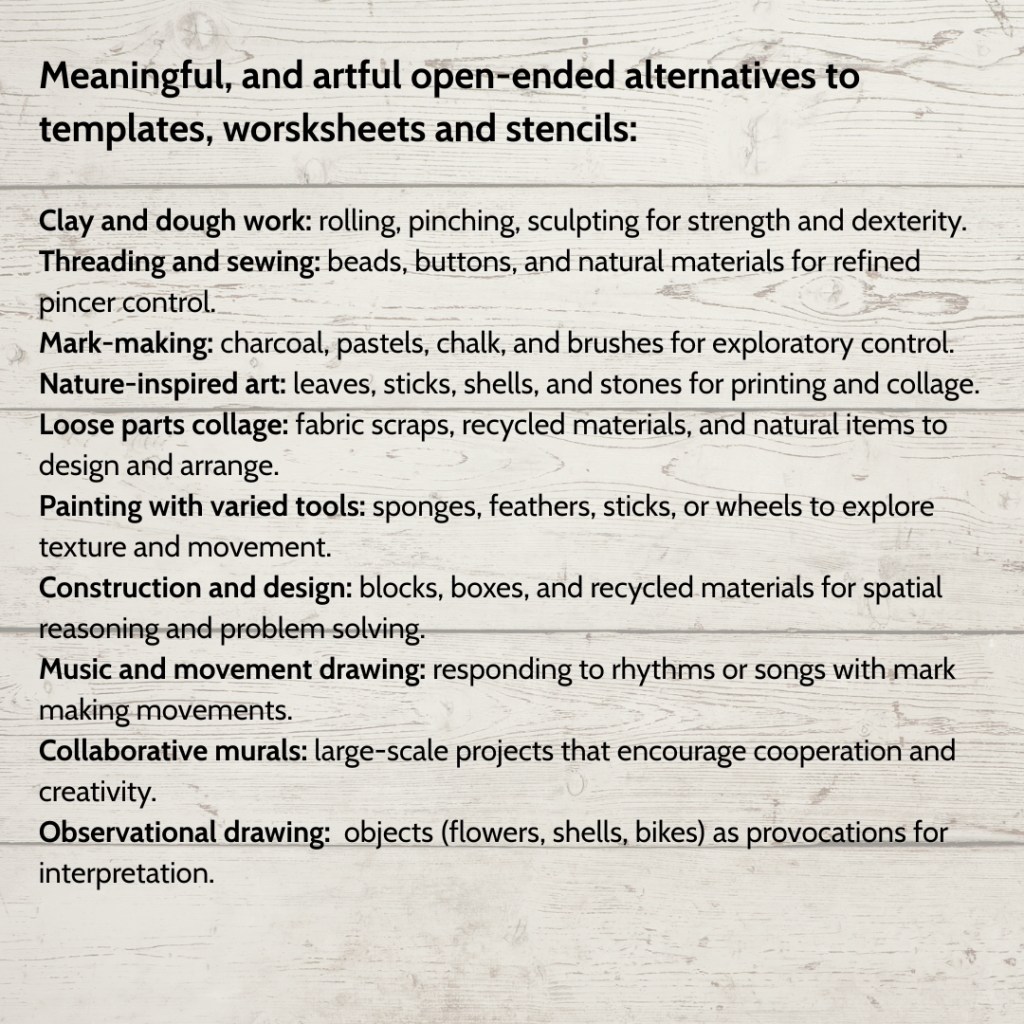
Templates, stencils and worksheets potentially impose adult‑determined outcomes, replacing exploration with compliance and reducing dialogue to direction. When every child’s work looks the same, individuality disappears. When expected to comply with such close-ended tasks, children can internalise a message that their ideas are inadequate unless they fit a prescribed shape, performance or outcome. In comparison, authentic arts practice invites children to design, interpret, and experiment. There are just so many rich and varied ways to meaningfully support children’s learning in playful and child-responsive ways that there should be no reason to resort to adult imposed activities. For example, the following open‑ended, child‑led visual arts learning experience suggestions offer much more meaningful, open‑ended pathways for skills and knowledge development:
The choice is complex
However, as already discussed, the arguments for and against stencils/templates and worksheets highlight that the issue is more complex than it may at first appear. Rather than “throwing the baby out with the bathwater,” our task is to deepen our knowledge and engage in critical reflection so we can recognise which approaches genuinely support children’s rights, agency, and creative expression; and which ones limit them.
To do this, considering the definition of the terms we use can be helpful and provoke reflection.
Defining stencils, templates and worksheets
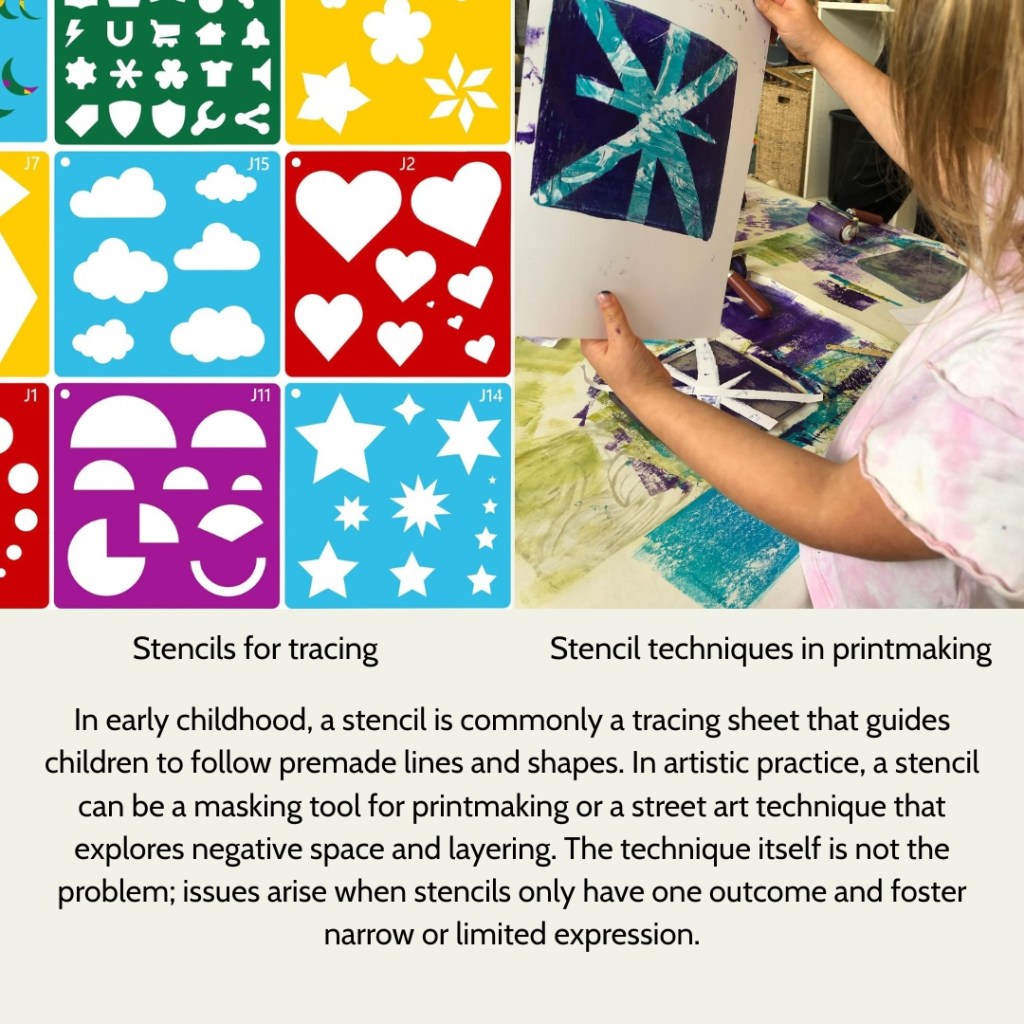
What do we mean by “stencil”, “template”, and “worksheet”? I believe many of the arguments and divisions on this topic could be resolved if everyone had shared understandings about the terms and definitions being debated. A lot of confusion also exists because many people judge ALL stencils and templates as a bad idea, when in fact, there are potentially positive and artistically informed ways to use stencils and templates as tools for open-ended artmaking…
Explaining the artistic use of stencils and templates may need to be unpacked in a future blog…But for now, it will suffice to consider the FULL definition of each of the term to appreciate the assumptions we make about how these terms are interpreted and used in different contexts. Think about how we could potentially frame these terms to align with open-ended arts processes rather than through adult-designed worksheets.

Worksheets
A preprinted work task that standardises outcomes and narrows responses to right or wrong. They often involve colouring-in busywork, pre-writing tracing exercises or testing tasks which require children to fill in the ‘correct’ answers. This limits children’s expression to filling-in or tracing predefined shapes, a form or testing-oriented busywork rather than process‑rich learning.
Stencils
Templates
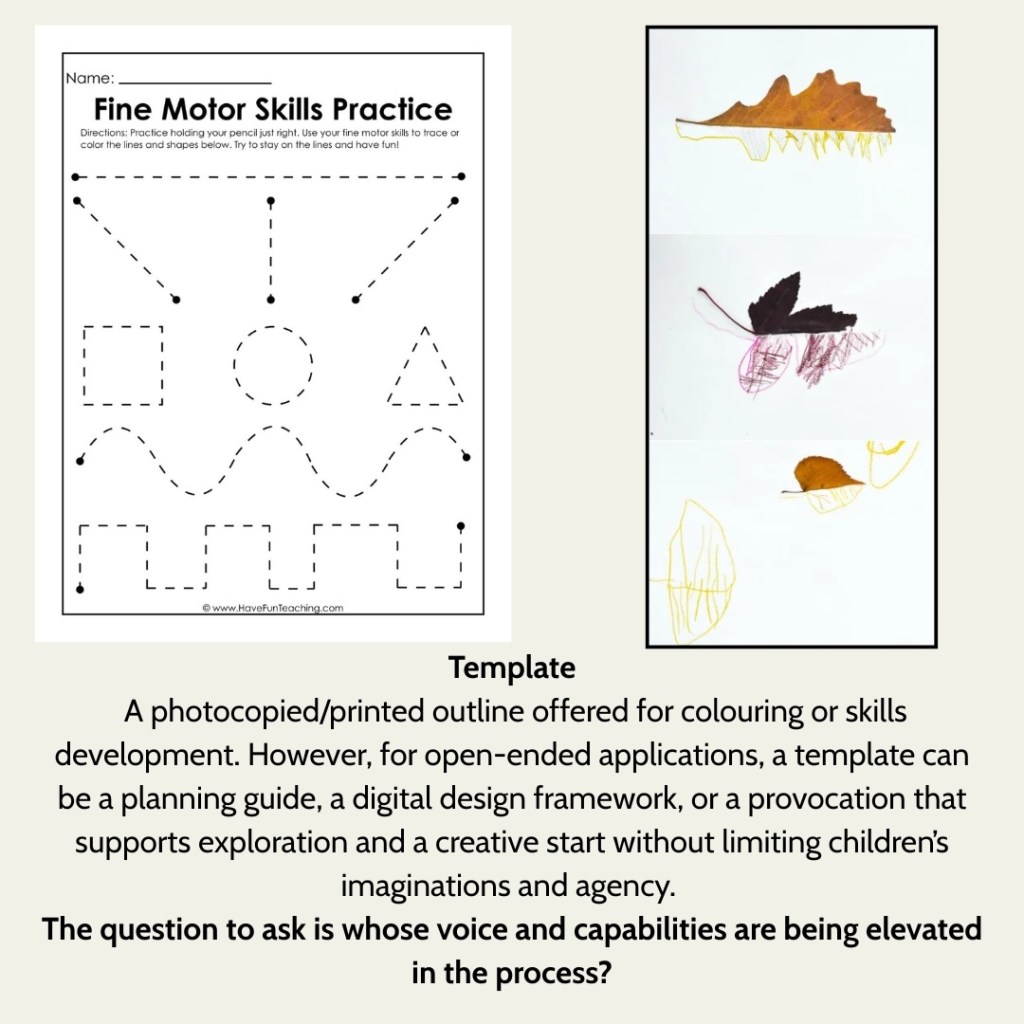
A QUESTION FOR REFLECTION:
Perhaps we can re-consider these definitions to add clarity to the ways we discuss busywork activities as opposed to the potential to apply artistic stencil and template use? But a template or stencil can also be categorised as limiting, adult-designed busywork…which we should all avoid when working with children – whose right it is to learn in and through play, inquiry and experience.
Stencil/template decision-making
Before offering any stencil or template, consider the following:
- Agency: Who chose this image or task, the child or the adult? Will the experience develop dispositions for learning and support a child to develop their unlimited potential? Are children being invited to explore, make choices, and lead their own learning? Will the experience support children’s active construction of knowledge?
- Intentionality: Why is this being offered, and what learning possibilities does it open? / is the focus on short‑term success rather than long‑term understanding?
- Possibility: Can the child transform, reinterpret, or extend it? Does the experience pressure the child to focus on the end result rather than the process?
- Relationship: Are we in dialogue with the child about process and choices?
If the answer to any of the above is NO – then perhaps it is time to reconsider your choices and pedagogical assumptions.
While stencils, templates, and worksheets may feel like harmless quick fixes or evidence of learning, they potentially undermine not only the essence of quality arts education, but children’s rights to agentic learning experiences. Without critical reflection and intentionality – some approaches to stencils, templates and particularly worksheets can limit creativity, reduce agency, and replace genuine learning and exploration with compliance. Our responsibility is to offer children real‑world, practical, pedagogically active learning experiences, diverse materials, and opportunities to make and create from their own ideas; building confident, imaginative thinkers who see art as a space for possibility, not prescription.
References
Australian Children’s Education and Care Quality Authority. (2026). Guide to the National Quality Framework. https://www.acecqa.gov.au/national-quality-framework/guide-nqf
Dewey. J. (1902). The Child and the Curriculum. The University of Chicago Press.
Lindsay, G., Probine, S., Denee, R., & Savins, D. (2025). Art play and inquiry: The why, what and how of visual arts education with young children. Routledge.
Pion, G. M., & Lipsey, M. W. (2021). Impact of the Tennessee Voluntary Prekindergarten Program on Children’s Literacy, Language, and Mathematics Skills: Results From a Regression-Discontinuity Design. AERA Open, 7. https://doi.org/10.1177/23328584211041353 \
 ecARToz: Inquiry & Arty Play with Dr Gai