
Dr Gai Lindsay, with Su Garrett and Mel Elderton (Explore & Develop, Annandale)
This blog post is a celebration of the investigation of the 2025 Muruduwin children, a group of three to five year old children at Explore & Develop Annandale. We acknowledge the Muruduwin teachers and educators who curated the children’s work: Linh, Heather, Sandra, Kirsty and Sharon Billinge (artist) who collaborated and partnered in the project.
Interconnected and enriching encounters
Sometimes a blog story emerges as a series of interconnected and enriching encounters!
One of the encounters which led to this blog began at the Semann & Slattery 2025 Inspire conference where I connected with several Early Childhood Education (ECE) colleagues from Explore & Develop Annandale. They spoke with me about how connecting with a community Fairy Wren art project funded by the Inner West Council and instigated by local inner-west artist Sharon Billinge had connected with the children’s interest in local wildlife. This wonderful story of practice will be outlined below, but first a little more context.
During the 2025 International Art in Early Childhood conference which I hosted in July 2025 at The University of Wollongong, I was very pleased to listen to a presentation titled ‘Art as a Bridge to Place and Culture’ by Melanie Elderton & Dia Prachakul from Explore & Develop Annandale in Sydney. The stories and examples shared during this conference presentation exemplified meaningful and community-connected projects of inquiry that engaged children in rich, community-connected learning experiences. Mel and Dia powerfully shared how visual arts languages are utilised to support children’s meaning-making, collaboration, communication and connection to place—while also nurturing their capacity for advocacy, ecological awareness, and civic engagement through sustained, relational inquiry. I invited the team at Explore & Develop Annandale to work with me to share their stories of practice to a wider audience. I was not surprised that the outstanding stories of practice articulated by Mel and Dia was happening in an Explore & Develop service. My connection with Explore & Develop began quite a few years ago when I was wandering through the Art Gallery of NSW. As I wandered, lost in the delight of the gallery spaces and collections, I came across a small group of preschoolers from the Explore & Develop Castlereagh St Early Learning Centre. You can imagine my delight to observe an educator supporting a small group of 6 preschoolers to observe and discuss artworks in the gallery. When I met them they were examining a 1996 painting by Gloria Tamerre Petyarre, calledcalled Awely for the mountain devil lizard (Twenty-one women)
[Image: Gai Lindsay, Explore & Develop, Castlereagh St Early Learning Centre visit to the Art Gallery of NSW]

With permission I took the image above which now features in my new book Art Play and Inquiry: The Why, What and How of Visual Arts Education with Young Children in the chapter related to engaging with the world of art, artists and galleries.
“Some might assume children are too young to appreciate the art and objects displayed in galleries and museum spaces. Others might think children don’t know how to behave in such spaces, worrying they might be too noisy or disrupt the experience for other (usually adult) visitors. However, those who exercise an image of the child as capable, agentic learners will embrace the opportunity to afford children (who are also citizens!) the right to visit public spaces. It is also important for the broader community to observe and delight in childrens’ engagement with art.” (Lindsay, Probine, Denee & Savins, 2025, p, 126)
More recently, I was delighted to be a keynote speaker at the 2025 Explore & Develop staff conference in Sydney. What a delight it was to deliver professional learning for an organisation that elevates visual arts pedagogy and practice as central to curious and joyful learning with and for children as citizens in their communities.
Another fortuitous meeting (or was it just one of those ‘meant-to-be’ encounters?) highlighted the synergy of connection in this blog was meeting artist Sharon Billinge when she and I were both engaged in Bundanon’s artist in Residence program earlier this year. Chatting over dinner together, Sharon described several of her community mural projects and particularly mentioned collaborating with a preschool group in connection with her Annandale and Lilyfield Fairy Wren project. Imagine my surprise suddenly realised she was the very Fairy Wren artist the team at Explore & Develop Annandale had earlier told me about when describing their culture of local environmental walks excursions and the ways they integrate visual arts methods to support children’s learning and expression of environmental advocacy.
But enough about the multiple threads of professional connection and dialogue that led to the production of this blog. Let’s hear from those involved directly in the project. Thanks for your reflections Kirsty (teacher with the children in the Muruduwin room), and to Su Garrett, Melanie Elderton and Sharon Billinge for their contribution to these reflections.
How the partnership with artist Sharon Billinge commenced
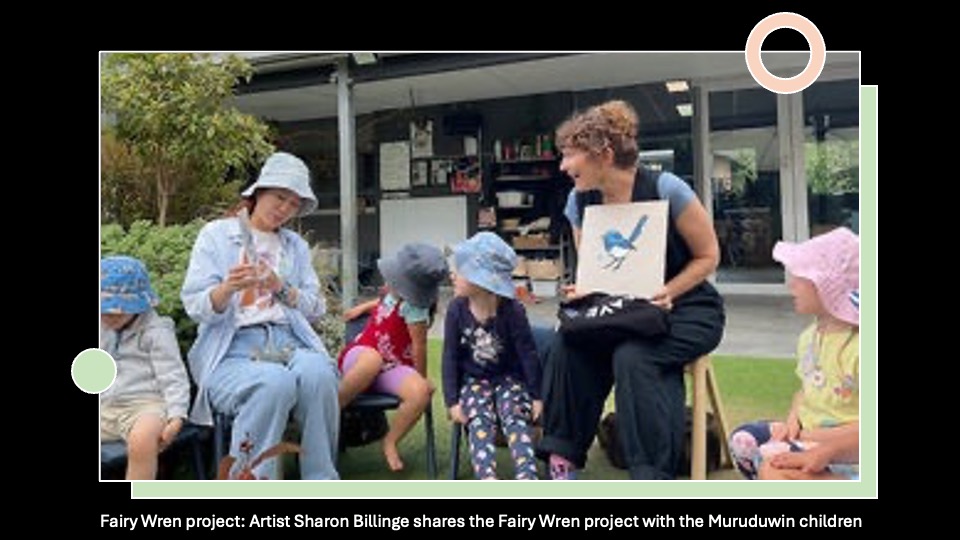
Su Garrett and Mel Elderton explain that Explore & Develop Annandale’s connection with Sharon began back in 2024, when the Council commissioned her to lead the Fairy Wren project—an inspiring initiative that brought to life a fairy wren trail winding through the streets of Annandale. This project not only celebrated local biodiversity but also promoted the creation of native green corridors to safeguard endangered species like the Superb Fairy Wren. Sharon wasn’t engaged to “teach” the children art. Rather, she visited the Centre several times to engage with the children to share her fairy wren stencilling process with us.
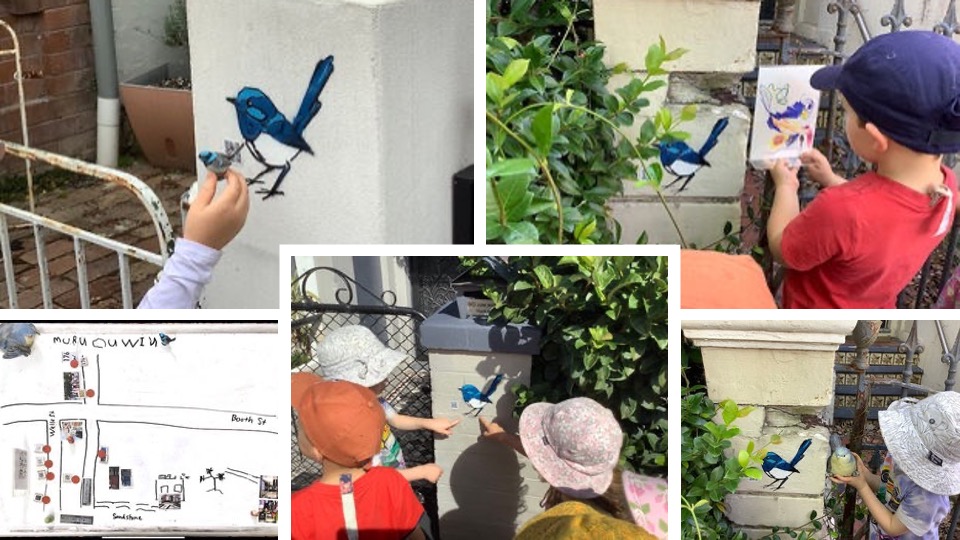
As a result, the educators and children from the Muruduwin (Fairy Wren) group engaged with Sharon’s fairy wren art in the community by walking the streets of Annandale looking for the stencils – they drew and painted lots of fairy wrens as a result of this initial project and even created their own walking map to record the local streets and fairy wren mural stop-points.

From Fairy Wren mapping to defending turtles!
Building on this momentum, in October 2024 Sharon reached out to us with an exciting invitation to collaborate on a new project, one designed to raise awareness and appreciation for the Eastern Longneck turtles that call our beloved Whites Creek Wetlands home.
Inner West Council had become increasingly concerned that native longneck turtles were being stolen from Whites Creek Wetlands, and they turned to local artist Sharon Billenge to create engaging signage that would help educate the community about the importance of protecting these remarkable creatures. The Council wanted children involved because they felt community members would connect if children’s voices and artwork were included on the signs to protect the turtles for future generations.
This invitation sparked a six-month journey of inquiry, advocacy, and artistic expression. The Muruduwin preschool children, alongside their educators, families, local artist Sharon Billinge, and the Inner West Council, embarked on a powerful exploration of citizenship, ecology, and creative activism. The children undertook an exceptional mission to co-design signage advocating for the eastern long-neck turtles, both the stolen and the existing. The children’s commitment to eco-advocacy, coupled with place-based pedagogy, resulted in a series of arts-based investigations at the Wetlands, particularly focusing on the life beneath, which sparked the children’s further interest in biodiversity, coexistence, and more.
The project wasn’t just about turtles—it was about relationships. Relationships with place, with each other, and with the broader community. As one educator, Kirsty, reflected, “The Wetlands have long held a special place in my heart…This slowness brought a new kind of focus and being in the space, and that was not just moving through it but being with and in the wetlands.” [NOTE: ‘Being with’ is a posthumanist term which recognises that existence is always relational and entangled, not just among humans, but with animals, materials, technologies, and environments. It shifts focus from individual autonomy to co-existence and mutual becoming; concepts that the Annandale Explore & Develop team discuss and explore with children in multiple ways.]

The following reflections about the project are shared with thanks using excerpts from Kirsty’s documentation which are written in BLUE.
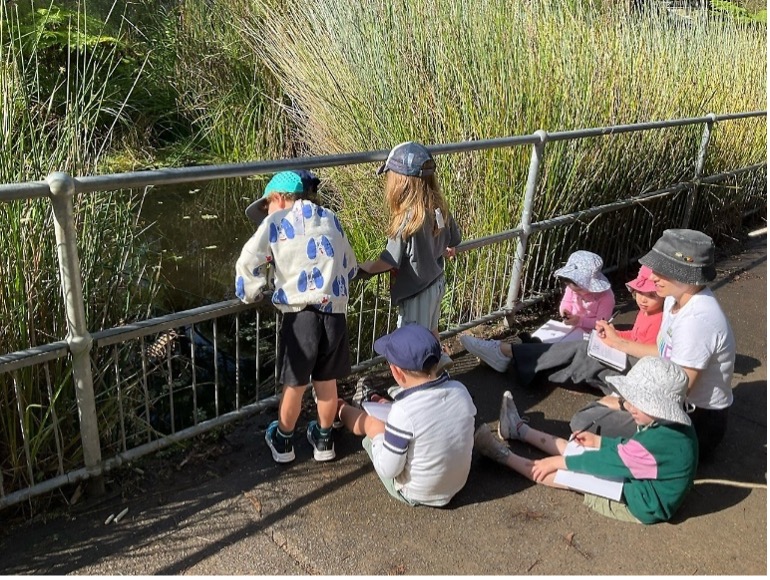
“As we sat, we noticed movements in the water and the children decided it must be the turtle moving. Shortly after the disturbance in the water, we spotted two eyes looking back at us, but these quickly disappeared under the water. As we spent more time here, we continued to notice eyes popping out of the water and then disappearing soon after. Gene decided that “the turtle must be shy” because it was a common thing for it to disappear when too many people were there. Then we saw some more eyes, this turtle looked different though and on closer inspection we noticed that it was actually a different turtle.” (Excerpt from Kinderloop reflection 31st March 2025)
The children had already been drawing turtles back at school as part of their ongoing research, but having the opportunity to observe real-life turtles transformed their engagement. They weren’t just illustrating an abstract idea anymore; they were observing, noticing subtle movements, changes in shell patterns, and the stillness required to see what we were not able to see through 2D images. Drawing became a bridge, not only between the children and the turtles, but between the children and their educators.
“While I had often engaging in drawing with a familiar group of children, something began to change. Children who had never before shown an interest in drawing started inviting me to sit with them. They sought out the drawing experience not only in the Wetlands but back at school as well, asking me to return to their work and revisit our shared observations. Drawing in this space wasn’t just a creative act, it became a shared language, a way of deepening our relationships with each other and with the place itself.” – Kirsty (Teacher)


The majority of our time together was silent, with an occasional check in of my work, praising my efforts and then briefly sharing the newest addition he added to his page. As I moved myself toward a warmer spot, Otto followed along. He chose a seat next to me and moved to the other side when his peers sat next to him. As everyone else’s interest in drawing reduced, he very happily acknowledged, “Hey Kirsty, it’s just you and me. No one else is here.” While I often spend time with Otto this would have to be the longest time we have spent together and it was so delightful.
Drawn to the place where the turtles live
One space in the Wetlands became our unofficial gathering spot. No matter where we began our explorations, we would always return there because that’s where the turtles were almost always waiting.
Whether we were drawing, observing, or simply sitting together, our interactions in the Wetlands became increasingly relational. I noticed children who, back at school, often chose other experiences or worked more closely with other educators, choosing to spend this time drawing beside me. These moments of shared attention, unhurried and grounded in place, enables new connections to emerge.
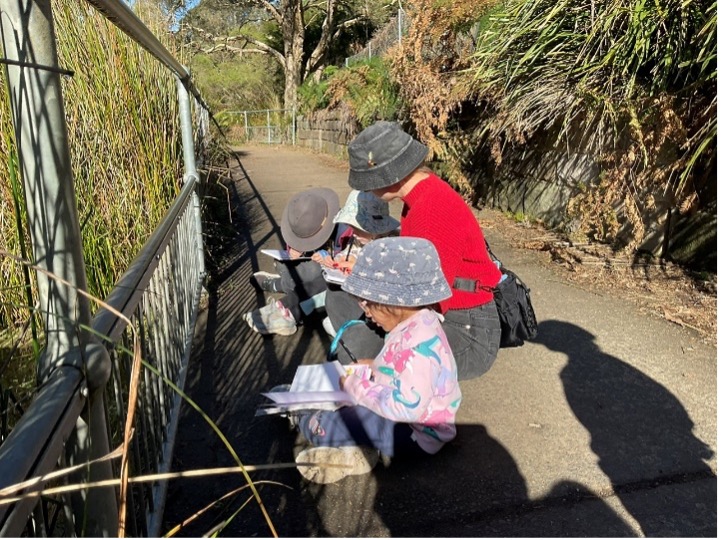
As I reflect, I now feel more connected to the Wetlands than ever before. This connection has shifted from one of familiarity to one of relationship. The turtles, and space slowed us down, regulated us, invited us into deeper noticing, and allowed our relationships with each other and the Wetlands to grow.
Concluding reflections about the project
I asked Sue Garrett and Mel Elderton what working with an artist on a local community project had meant for the children and staff at Explore & Develop Annandale. They noted that engagement with a local artist throughout this extended community project had significantly contributed to a deeper understanding and appreciation of children’s citizenship. They identified that the project had supported children to:
- Position themselves as artists whose work holds meaning, is open to interpretation, and can be used as a vehicle for expressing and promoting their ideas.
- Engage in sustained and collaborative thinking, with children engaging as a collective of artist-activists.
- Connect to issues of environmental sustainability in ways that were both visible and meaningful for children.
- Actively participate in actions aimed at addressing these issues, embedding sustainability as an integral and authentic component of the curriculum design.
- Strengthen connections with their local community.
The project also powerfully supported educators and families to recognising children as active participants in civic life. In this way, the initiative not only enhanced educational outcomes but also highlighted the broader role of children as capable and engaged citizens. The artist Sharon Billinge reflected on her experience of working with the children and educators at Explore & Develop Annandale, highlighting that when such partnerships are fostered everyone learns and benefits and children’s capabilities and voices are valued:
“I found working with the children very rewarding and the quality of the work they produced really surprised me. It was great to be able to come into the centre a number of times so we could build up a bit of a relationship and the dedication of their educators really shone through. I was blown away by the depth of the work that they produced and how they were supported to make a diverse range of responses to the project. I hadn’t realised that they would take it in so many directions – maps, animation, walking tours, drawings, needlework – the possibilities that they came up with seemed endless.” – Sharon Billinge

The visual arts are a powerful medium for connecting children to their communities, environments, and cultural traditions. Through art-making, children become active participants in learning that is deeply relevant to their lives and contexts. These experiences not only nurture creativity but also foster ecological awareness and a sense of belonging.
Incorporating environmental art practices into education invites children to engage with pressing global issues in age-appropriate ways, positioning children as thoughtful citizens who can share their ideas and theories to contribute to sustainable futures. When educators create opportunities for children to explore and represent local places and issues through art, they affirm children’s visibility and agency within those spaces. Such practices strengthen relational pedagogy, deepen community connections, and encourage both educators and children to reflect on their roles in caring for the world.
To conclude, I offer some hints and tips for connecting and working with artists in your community (for more, see chapters 8 and 9 in Art Play and Inquiry):
Connecting with Local Artists – Key Ideas for Educators
- Explore your local arts scene
- Visit galleries, attend exhibitions, and look out for public art events.
- Investigate public artworks in your community to discover potential artist collaborators.
- Ask about local council projects you could support/connect with.
- Recruit with respect and intention
- Choose artists who value young children as capable, creative citizens.
- Ensure artists are comfortable and enthusiastic about working in educational settings and with young children (do they believe children are capable?)
- Acknowledge artists’ professionalism
- Offer fair payment for their time and expertise.
- Avoid assuming artists will work voluntarily.
- Connect with artists employed on funded local community projects
- Start small and build relationships
- Invite artists to visit your setting and share examples of their work.
- Consider excursions to their studios or workshops to deepen engagement.
- Design meaningful collaborations
- Collaborate on projects ranging from simple visits to co-creating artworks with children.
- Encourage artists to share their methods, techniques, and creative processes.
- Support children’s artistic understanding
- Help children connect the artist’s identity, process, and final artwork.
- Broaden children’s views of what art is and how it can be made.
- Value mutual learning
- Recognize that artists gain fresh perspectives from children’s interpretations and ideas.
- Celebrate the joy and wonder children bring to artistic experiences.
Thanks again to the Explore & Develop Annandale team for generously sharing their work in this blog. They will soon be making this project available as a book, largely for families in the service, but also available for purchase by educators to consider ways they can work with local community (and local artists) to support children’s learning and community engagement. As soon as the link to access the book is available – we will post it here.
Please also note that I welcome the opportunity to share exemplary visual arts related projects and practice from across the Early Childhood Sector. If you have a story you would like to share and co-author via a mentored blog post – please contact me via the contacts page on my website https://drgai-lindsay.com.au/
With thanks, Dr Gai Lindsay
 ecARToz: Inquiry & Arty Play with Dr Gai