
A practice exemplar to inspire reflection and practice
Dr Gai Lindsay in partnership with Bei Bei Liu.
This blog introduces you to the work of a fabulous educator who works at KU Bradfield Park. I first connected virtually with Bei Bei Liu when she submitted children’s artworks in the 2021/2022 Voices of Children project, a Bright Start early arts project I was involved in. At that time, I was amazed by the depth of her reflection and practice in relation to utilising visual arts pedagogy to elevate children’s voices within projects of inquiry. Then, in 2022 at the KU Children’s Services 125-year anniversary event, I happened to sit next to Bei Bei when a video production created by the children at KU Bradfield Park was launched. We talked a great deal that night about our common passion for visual arts pedagogies that honour the child. I immediately knew that early childhood professionals and students would benefit from hearing about Bei Bei’s work and reflective practice. Thanks so much to KU Children’s Services, and particularly to Fran Bastion, Sally Beesley, Bei Bei Liu and the children of KU Bradfield Park, for generously giving their consent for the production of the video content embedded in this blog.
There is so much rich thinking in the series of short videos edited from a recorded discussion I had with Bei Bei. Rather than analyse each video, I have elected to supplement each of the 8 videos with some key points and quotes that stood out to me as points for further reflection and provocation. But first, please watch the culminating production that came from the exemplary project of inquiry Bei Bei and the KU Bradfield Park team conducted with children to explore “Yesterday Today Tomorrow at KU Bradfield Park.
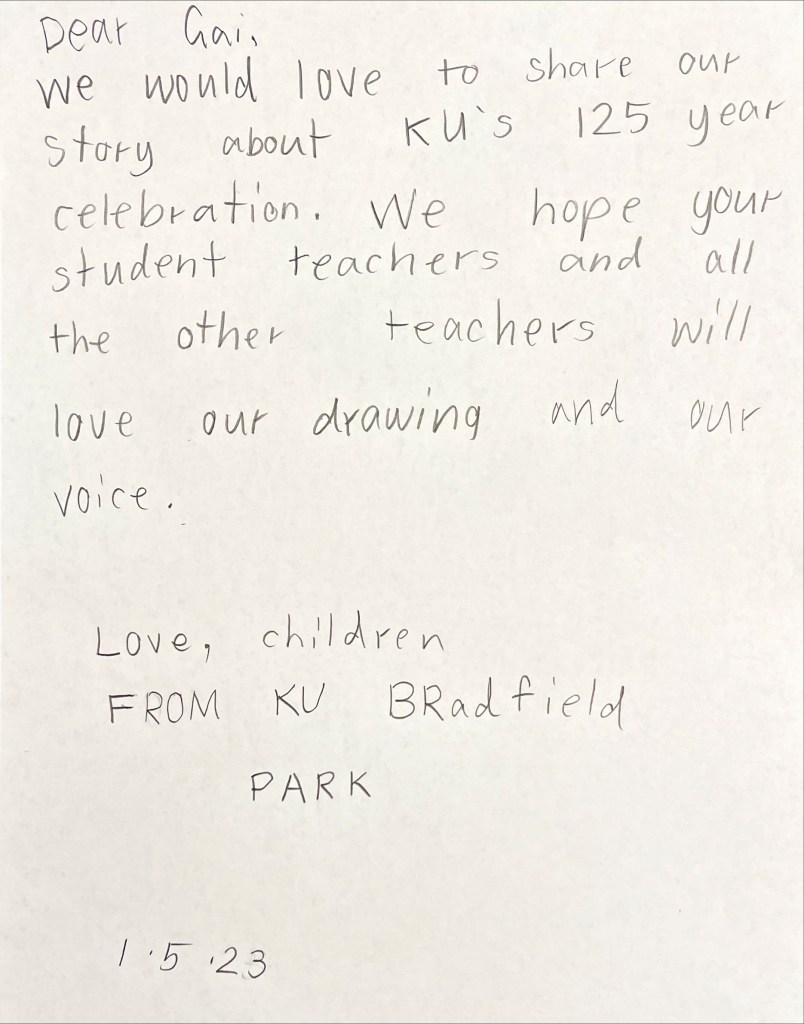
Thanks to Bei Bei for consulting with the children who were involved in this project and for sharing the children’s letter of consent for their work to be included in this blog post. A very helpful guide for consulting children and engaging them in decision making can be accessed here.
PART 1. Firstly, please watch the following video to meet Bei Bei and learn about her work context.
PART 2. Learning project decision making.
- Engage children in powerful learning about their questions, wonderings, planning and reflection
- Plan together in stakeholder meetings
- Listen to children.
- Focus on what children are paying attention to
- Try to figure out what children are curious about
- Start with children’s questions and wonderings
- Consider children’s point of view
- Choose learning materials to support children’s 100 languages.
- Relaunch and revisit previous learning
- Build on and expand perspectives
- Follow children’s lines of inquiry
- Embrace uncertainty
“This is the truly joy of teaching and learning together with the children that means we learn together and we learn from each other.”
Bei Bei Liu
PART 3: Why Projects of Inquiry?
- When children engage in open-ended art making they bring different strengths and capacity.
- Children’s art may focus on storytelling, expression, representation and articulation of their thinking and emotions and making sense of their theories.
- Children “need someone to sit alongside with them, to work with them, to wait for them to be ready to hold our hands to guide us through the project.”
“It is such a joy to see the children’s individual art and to witness their ideas bounce off each other.”
Bei Bei Liu
PART 4: Choosing and exploring materials
- Support children’s sense of agency
- Set up a dedicated art space: “By saying that, it means the easels, watercolor, paint, chalk, charcoal, clay, collage materials, natural loose parts – they are always there for children to explore….So the children are very familiar with those materials and how to use them.”
- Invest time and build arts repertoire through repeated experience.
- Maintain consistent expectation that children are capable of using and caring for materials.
- Scaffold experience with materials so that children get lots of practice with using materials as a prelude to using materials to make and express meaning in projects of inquiry.
- Educators engage with the children and model the arts languages and the dialogues of materials with children.
Part 5. Intentional teaching and inquiry ( Thinking about the educator’s role)
- The role of the educator is to “be the listener and always just listen to children” and to “collaborate and be a companion to them…to sit alongside them, to walk the journey with them through the project.”
- To be a co-learner, co-researcher and a co-teacher means that the child is teaching you as much as you’re teaching them.
- “Be patient….there’s not a right or wrong answer” (when engaging in projects with children).
- Celebrating the learning as it’s happening without necessarily having a set end product or set outcome in mind.
Part 6: Provocations for thinking
- “Children [firstly] represent their thinking and they look at their thinking and think about their thinking (metacognition)…And I look at their thinking and think about my thinking and we just collaborate and each other.”
- Seek out the magic moments.
“We need to live in that moment with the children, you know, be open-ended. Open our our heart and think about it. What resonates with us?”
Bei Bei Liu
Part 7: Documenting and reflecting on children’s interests
- Rather than focusing on children’s ‘interests’ (it can be difficult to evaluate what children are really interested in) focus on their ideas, stories and their thinking.
- Advocate and honor children’s processes of learning, collaborating and exploring.
- “Remember not to rush the children and hijack their ideas with teachers scripts.”
- Bei Bei mentions Ann Pelo’s thinking lens which guides reflection and documentation. READ MORE HERE.
“It’s about the process. It’s about the reflection. It’s about … how we support [children] and facilitate [their learning]. It’s the learning together.”
Bei Bei Liu
PART 8 PRACTICAL PROJECT EXAMPLE – The KU 125th year celebration.
- Take the time to listen to children’s voices and give them a platform, a visual platform to express their thinking and their ideas.
“Take a little small step and be brave. Just keep listening to the children. You will get there….Just be brave.”
Bei Bei Liu
Further resources to support your thinking and learning about the project approach and inquiry based research with children.
Picturing the Project Approach Book (Chard, Kogan & Castillo)
 ecARToz: Inquiry & Arty Play with Dr Gai